
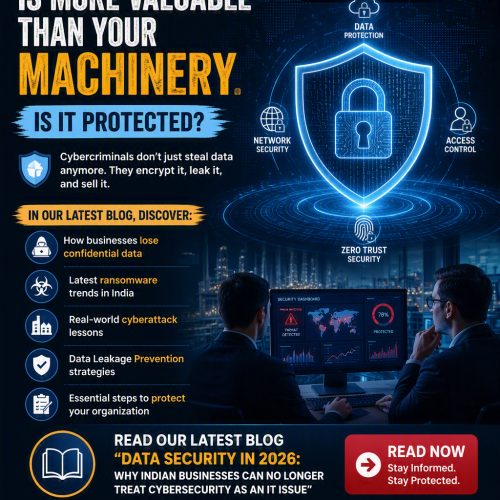
Data Security in 2026: Why Indian Businesses Can No Longer Treat Cybersecurity as an IT Issue
India’s digital economy is growing at an unprecedented pace. Businesses are embracing cloud applications, remote work, AI-powered tools, CRM platforms, and digital collaboration systems. While this transformation has improved productivity, it has also exposed organizations to a new generation of cyber threats.
Today, data is one of the most valuable business assets. Customer databases, financial records, intellectual property, employee information, and operational data have become prime targets for cybercriminals. As cyberattacks grow more sophisticated, organizations must shift from reactive security measures to a proactive data protection strategy.
The Rising Cyber Threat Landscape in India
Recent cybersecurity reports reveal a concerning trend. The India Cyber Threat Report 2025 identified over 369 million malware detections across 8.44 million endpoints, highlighting the scale of cyber risks faced by Indian organizations. The report also found increasing threats from AI-powered malware, ransomware, supply-chain attacks, and targeted digital extortion campaigns.
CERT-In’s India Ransomware Report 2024 further highlighted the growing use of ransomware attacks against Indian organizations, particularly in sectors such as IT services, manufacturing, and healthcare. Attackers are increasingly using “double extortion” techniques, where they not only encrypt data but also threaten to leak it publicly.
For manufacturing companies, SMEs, healthcare providers, and financial organizations, cybersecurity is no longer optional. It is a business survival requirement.
The Real Cost of a Data Breach
Many businesses believe cybersecurity investments are expensive. However, the cost of a breach is often significantly higher.
According to IBM’s Cost of a Data Breach Report, the average cost of a data breach in India reached INR 195 million in 2024, the highest ever recorded. The major contributors included operational downtime, customer loss, reputational damage, incident response costs, and regulatory requirements.
The report also found that phishing attacks and stolen credentials remain among the most common attack methods, proving that human error continues to be a major weakness in many organizations.
For smaller businesses, even a single successful cyberattack can result in:
- Loss of customer trust
- Operational interruptions
- Financial penalties
- Legal liabilities
- Permanent brand damage
Why Data Leakage Is Becoming a Bigger Threat
While ransomware often receives media attention, data leakage remains one of the most dangerous and overlooked risks.
Data leakage occurs when sensitive information leaves the organization without authorization. This can happen through:
- Employee negligence
- Weak password practices
- Misconfigured cloud storage
- Unauthorized USB devices
- Compromised email accounts
- Insider threats
- Third-party vendor vulnerabilities
In many cases, organizations discover a data leak only after confidential information appears online or in the hands of competitors.
As businesses increasingly rely on cloud platforms and hybrid work environments, controlling data movement has become more challenging than ever. IBM research shows that a significant portion of breaches involve cloud environments and data distributed across multiple systems.
Emerging Cybersecurity Trends in 2026
1. AI-Powered Cyberattacks
Cybercriminals are using artificial intelligence to generate convincing phishing emails, automate attacks, and identify vulnerabilities faster than traditional methods. Security teams must adopt equally advanced detection and response capabilities.
2. Targeted Ransomware Attacks
Modern ransomware groups are no longer targeting only large enterprises. SMEs and manufacturing companies are becoming attractive targets because they often have weaker security controls.
3. Supply Chain Vulnerabilities
A single compromised vendor can provide attackers access to multiple organizations. Recent reports indicate growing concerns around software supply chain attacks and third-party security risks.
4. Zero Trust Security Adoption
Organizations worldwide are shifting toward Zero Trust models based on the principle of “Never Trust, Always Verify.” Every device, user, and application must continuously prove legitimacy before access is granted.
5. Regulatory Compliance and Data Privacy
With the Digital Personal Data Protection (DPDP) Act shaping India’s privacy landscape, businesses must demonstrate responsible handling and protection of customer information. Strong security practices are becoming both a legal and operational necessity.
Practical Steps Every Business Should Take
To reduce cybersecurity risks and prevent data leakage, organizations should:
Implement Multi-Factor Authentication (MFA)
Protect accounts beyond passwords and prevent unauthorized access.
Deploy Data Loss Prevention (DLP) Solutions
Monitor, control, and protect sensitive information from leaving the organization.
Conduct Employee Security Training
Most attacks still begin with human error, making awareness programs essential.
Regularly Backup Critical Data
Maintain secure offline and cloud backups to ensure business continuity.
Continuously Monitor Endpoints and Networks
Identify suspicious activity before it becomes a major incident.
Secure Email Systems
Since email remains a primary attack vector, advanced email security solutions are critical.
Adopt Zero Trust Principles
Verify every user and device continuously rather than relying on perimeter-based security.
The Future of Business Depends on Data Security
Cybersecurity is no longer just an IT department responsibility. It is a boardroom priority, a compliance necessity, and a business growth enabler.
Organizations that invest in robust cybersecurity frameworks, data leakage prevention, employee awareness, and continuous monitoring will be better equipped to thrive in an increasingly digital world. Those that delay may face financial losses, operational disruption, and reputational damage that could take years to recover from.
At SKYTECH TECHNOLOGIES, we believe that every business deserves enterprise-grade protection regardless of its size. Through advanced cybersecurity solutions, data protection technologies, secure email systems, and proactive threat management, we help organizations safeguard what matters most: their data.
Because in today’s digital economy, data security is not just about protection. It is about business continuity, customer trust, and long-term success.
Cyber threats are evolving every day. From ransomware attacks to data leakage incidents, organizations of all sizes are becoming targets.
At SKYTECH Technologies, we help businesses secure their critical data through:
✅ Data Leakage Prevention (DLP) Solutions
✅ Advanced Email Security
✅ Endpoint & Network Protection
✅ Cloud Security Solutions
✅ Ransomware Protection & Recovery Planning
✅ Security Assessments & Consulting
Contact SKYTECH Technologies Today
📞 +91 94286 29855
📧 info@skytechtechnologies.com
🌐 https://skytechtechnologies.com
Frequently Asked Questions
What is Data Leakage Prevention (DLP)?
Data Leakage Prevention (DLP) helps organizations identify, monitor and prevent unauthorized sharing or leakage of sensitive information.
Why are manufacturing companies vulnerable to cyberattacks?
Manufacturing organizations often store valuable customer, production and financial data. Cybercriminals target these businesses using ransomware, phishing and data theft attacks.
How can businesses reduce ransomware risks?
Implementing Multi-Factor Authentication (MFA), employee awareness training, regular backups and endpoint protection significantly reduces ransomware risks.
What is Zero Trust Security?
Zero Trust follows the principle of “Never Trust, Always Verify” by continuously validating users, devices and applications before granting access.